Review of Japanese version of “Connect & Manage”
Making efforts for efficient use of power grids
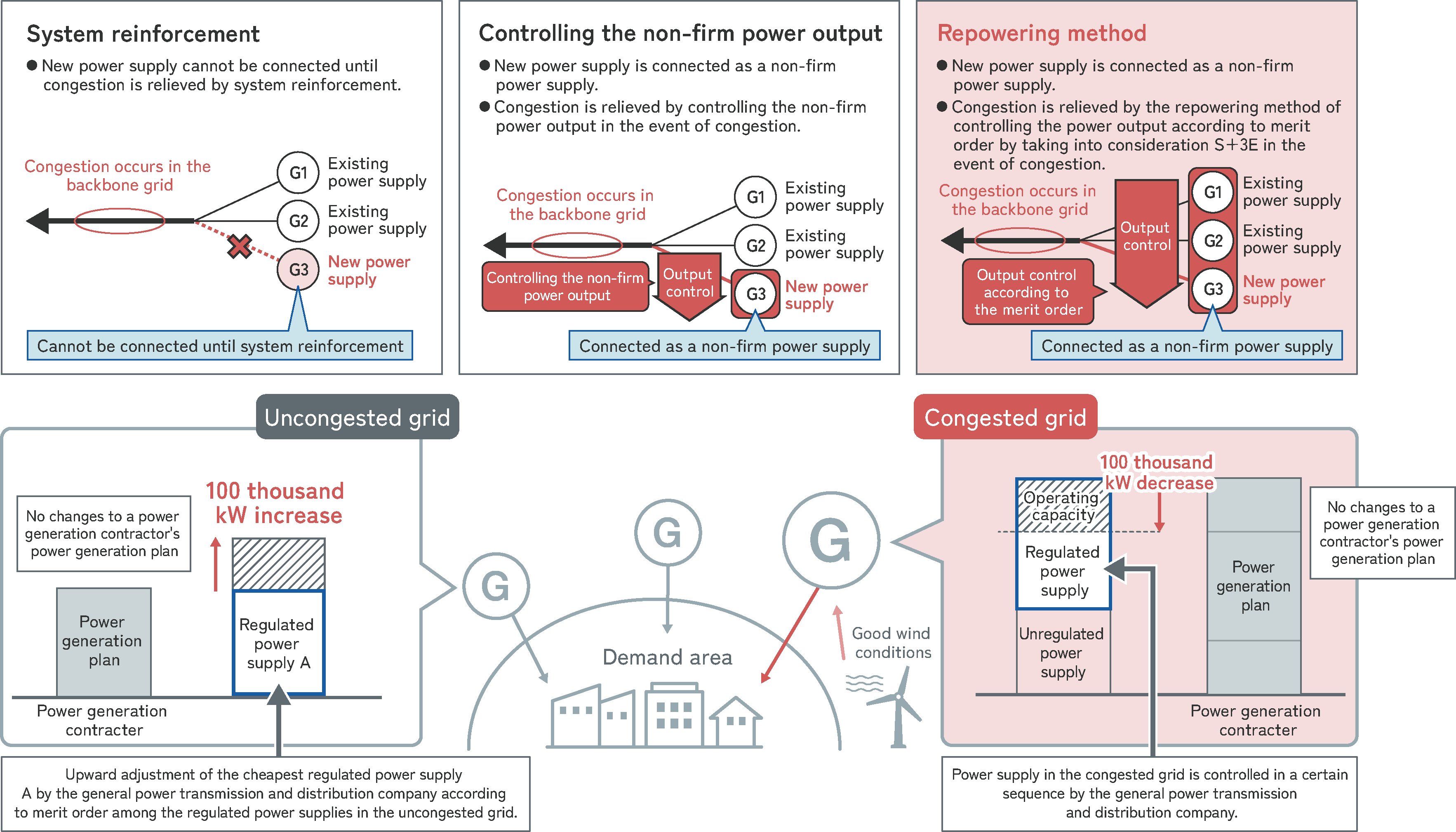
To promote the introduction of renewable energy, while maximizing the use of existing transmission and substation facilities, OCCTO continues with Connect & Manage (such as the N-1 Inter-trip scheme and non-firm connection), which allows flexible power supply connection on the premise of appropriate management during grid congestion, by revising the previous approach of not allowing new power supply connections until the grid is reinforced if there is no available capacity based on the maximum output of existing power generation facilities.
Furthermore, in order to extract as much value as possible from the connected power source, a repowering method is introduced into the backbone grid as a congestion management method.
Connect & Manage
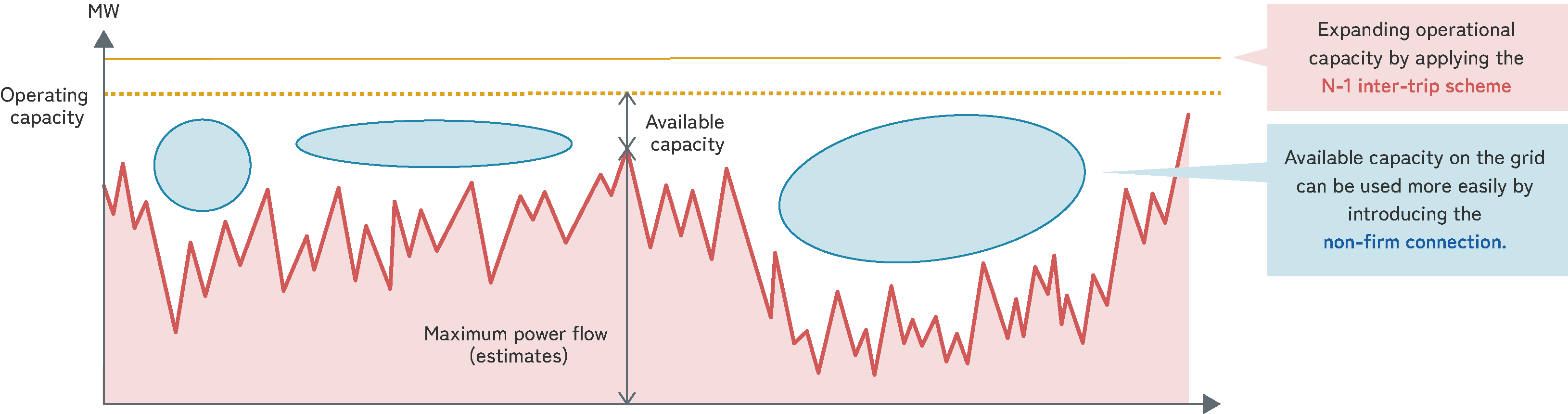
N-1 inter-trip scheme
In Japan, in terms of grid reliability, facilities are constructed to ensure stable transmission capacity even in the event of an N-1 failure, such as a failure of one of the transmission lines that usually have two circuits. The N-1 inter-trip scheme is a system that allows the capacity to be utilized during normal situations by limiting power supply in the event of an N-1 failure.
Non-firm connection
This is a new approach to power supply connection to allow operation when there is availability on the grid by connecting new power sources to the grid without system reinforcement, assuming output control during grid congestion.
Redispatching method
The redispatching method is a method of controlling the power output according to merit order by taking into consideration the stable supply, in contrast to the method of controlling the non-firm power output in managing grid congestion. Specifically, in order to mitigate congestion in the backbone grid, the output of the power output connected to the backbone grid will be curtailed in a certain sequence, and the output of regulated power supply in the uncongested grid will be controlled based on merit order according to the amount of power shortage caused thereby to match the power supply and demand.