
Study and detailed designing of co-optimization market (i.e., simultaneous contracted market for electric energy and balancing capacity)
Aiming at introduction of a system to execute trades of electric energy (kWh) and balancing capacity (ΔkW) simultaneously
Recently, against the backdrop of an increase in variable renewable energy sources and materialization of risks associated with fossil fuel procurement, various issues involving insufficient selling bids and price surges in the wholesale electricity trading market and the supply-demand balancing market, increased difficulty to maintain balance between supply and demand in power grids, and the occurrence and increase in grid congestion have emerged. These issues are expected to become more serious after the massive integration of variable renewable energy sources in the future.
Under such circumstances, the establishment of a new market (co-optimization market) is considered as a system that enables more stable and efficient operation of power sources, while handling the issues of the stable procurement and distribution of electric power and balancing capacity, trade execution considering the cost characteristics of power sources and other matters, and the establishment of a system of supply-demand operation that is able to adapt to the future environmental changes.
Currently, electric energy (kWh) and balancing capacity (ΔkW) are traded separately in the wholesale electricity trading market and the supply-demand balancing market, respectively. Meanwhile, in the co-optimization market, electric energy and balancing capacity are traded and contracted simultaneously. In order to solve such problems as the contention for power sources arising from separate operation of each market, we will introduce a system to properly allocate power sources to the electric energy and the balancing capacity to make it possible to prevent price surges due to insufficient selling bids and to secure sufficient balancing capacity to respond to an increase in variable renewable energy sources. In addition, through the introduction of a system that records the cost characteristics (startup cost, minimum output cost, and incremental cost) of power generators upon bidding, enables the optimization of power generation costs upon trade execution in the market, and decides the power sources to be traded and the amount of power generation by considering the grid constraints, an operation based on the stable and efficient power source status will become possible, even when the variable renewable energy sources are massively integrated to girds.
To this day, discussions on the system design of the co-optimization market have been held by the study committee on the co-optimization market (joint secretariat of the Agency for Natural Resources and Energy, and the OCCTO), and the whole picture of co-optimization market under review was depicted in the second interim report published on October 15, 2025.
In future, toward the introduction of co-optimization market scheme, we plan to make a detailed design of the market scheme based on a practical perspective and to define requirements for the development of the market scheme necessary for the introduction of the co-optimization market sequentially.
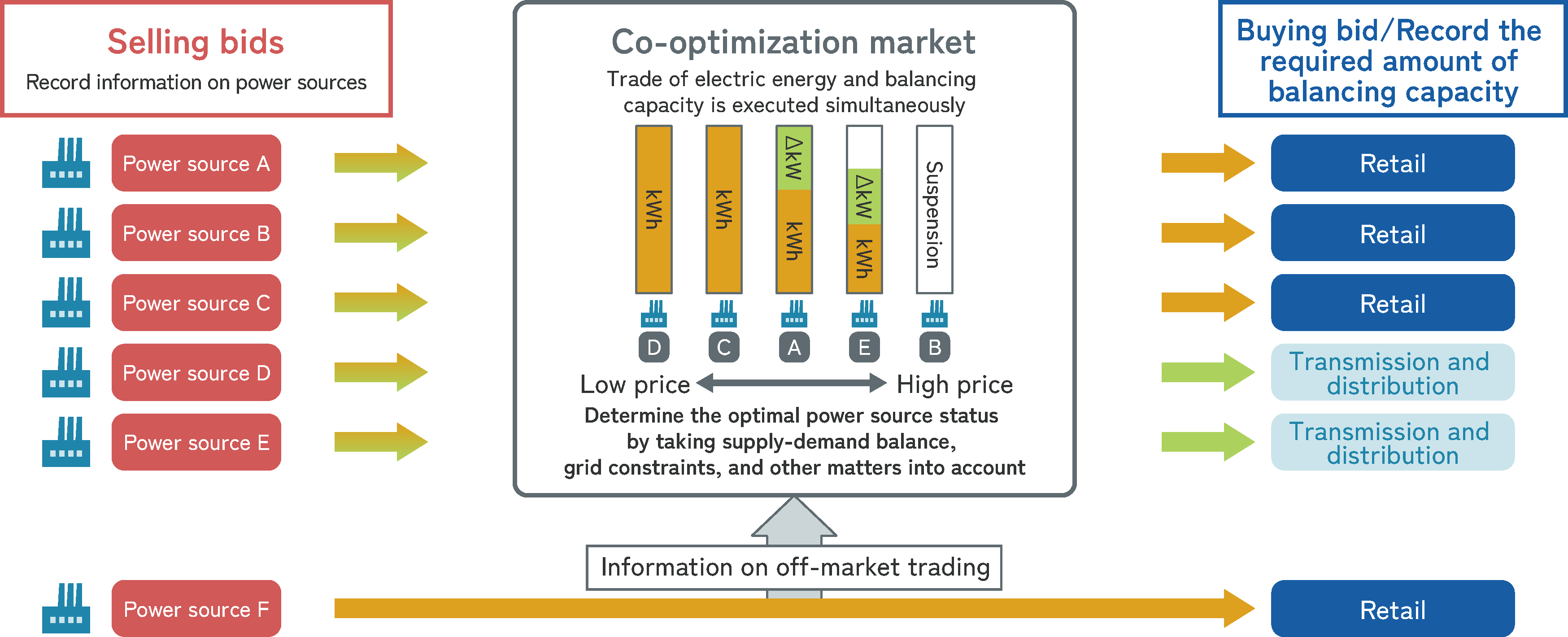
(website of the Agency for Natural Resources and Energy)